Bauhaus Style: Elevating Modern Design with Geometric Precision
The enduring appeal of Bauhaus Style lies in its radical simplicity and functional elegance. Emerging from the influential German art school of the early 20th century, this design philosophy revolutionized how we perceive form, color, and structure. Today, it remains a cornerstone of modern aesthetics, offering designers, artists, and creators a timeless toolkit for visual communication. Whether you are developing a brand identity, creating digital assets, or designing physical products, understanding and utilizing Bauhaus principles can transform your work from ordinary to iconic.
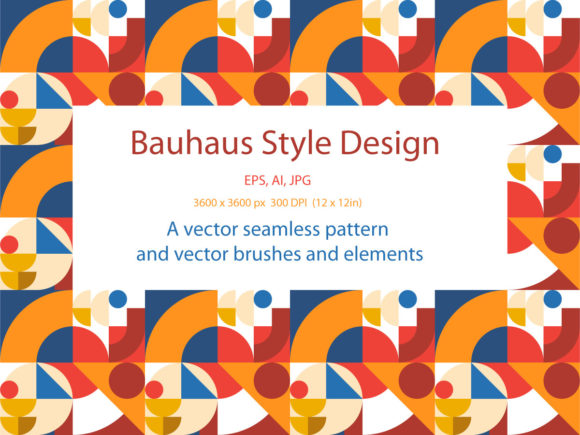
For many creative professionals and hobbyists, the challenge is not a lack of ideas, but a lack of cohesive visual language. In a saturated digital marketplace, standing out requires clarity and impact. This is where the structured approach of Bauhaus design becomes invaluable. By stripping away unnecessary ornamentation and focusing on geometric purity, you create designs that are both visually striking and highly versatile. The integration of retro Bauhaus style seamless patterns and geometric vector brushes provides a practical solution for those seeking to implement this aesthetic without starting from scratch.
Understanding the Core Principles
At its heart, Bauhaus Style is about the harmony between art and technology. It champions the idea that form follows function. This means every element in a design should serve a purpose. Visually, this translates to the use of basic geometric shapes—circles, squares, and triangles—combined with a primary color palette of red, blue, and yellow, often balanced by black, white, and gray. This minimalism is not empty; it is intentional. It allows the viewer’s eye to rest while simultaneously drawing attention to the core message or product.
When applying these principles to contemporary projects, such as digital scrapbooking or web page backdrops, the goal is to achieve balance through asymmetry and dynamic composition. The use of negative space is just as important as the filled areas. A well-executed Bauhaus-inspired design feels open, airy, and organized, even when it contains multiple elements. This clarity is particularly beneficial for users who need to convey complex information quickly, such as in posters, banners, or packaging design.
Practical Applications for Creators
The versatility of geometric vector backgrounds and seamless patterns makes them an essential resource for a wide range of applications. For graphic designers, having access to scalable EPS and AI files means that the artwork can be adapted to any dimension without losing quality. This is crucial for professional output, whether you are designing a small greeting card or a large-format banner for an event. The ability to fill any object with these patterns in Adobe Illustrator allows for endless customization, ensuring that each project retains a unique fingerprint while adhering to the cohesive Bauhaus aesthetic.
Consider the needs of a small business owner looking to upgrade their packaging. Using high-resolution JPG images of tileable Bauhaus patterns can instantly elevate the perceived value of a product. The clean lines and bold colors communicate professionalism and modernity. Similarly, for fabric print and cloth design, these seamless patterns ensure that the repetition is invisible, creating a continuous, flowing texture that is pleasing to the touch and the eye. This is equally applicable to wrapping paper, where the geometric precision adds a layer of sophistication to gift-giving.
Digital creators also benefit significantly from these resources. Web page backdrops require images that are lightweight yet visually engaging. A geometric vector background offers sharp edges and clear definitions that look crisp on high-resolution screens. For digital scrapbooking and card making, the availability of source swatches in the swatches panel simplifies the workflow. Users can easily recolor elements to match specific themes or brand guidelines, saving hours of manual editing time.
Overcoming Design Challenges
One common hurdle for non-designers is achieving professional-looking results without extensive training. Traditional design software can have a steep learning curve, and creating seamless, tileable patterns from scratch requires technical knowledge of vector paths and repetition logic. By utilizing pre-made collections that include edited, repeated, and tileable patterns, users bypass these technical barriers. The inclusion of corresponding source swatches ensures that the patterns integrate seamlessly into existing workflows, allowing users to focus on creativity rather than mechanics.
Another challenge is maintaining consistency across different media. A pattern that looks good on a screen may not translate well to print if the resolution is insufficient. High-resolution files measured at 12 x 12 inches with 300 DPI ensure that printed materials, such as posters and greeting cards, remain sharp and vibrant. The RGB color profile is ideal for digital displays, providing bright and accurate colors for web and screen-based projects. Understanding these technical specifications helps users avoid common pitfalls like pixelation or color shifting.
Tailoring the Approach to Your Needs
Different users will approach Bauhaus Style in distinct ways, depending on their goals. A professional graphic designer might use the scalable AI files to deconstruct the patterns, isolating specific geometric elements to create custom logos or icons. They value the flexibility and editability of vector formats, which allow for precise manipulation of anchor points and paths.
In contrast, a hobbyist engaged in digital scrapbooking or card making may prefer the ease of use offered by high-resolution JPG images. These files can be dragged and dropped directly into layout software, providing immediate visual impact without the need for advanced vector editing skills. The seamless nature of the patterns means they can be tiled extensively to create rich, textured backgrounds that enhance photos and text without overwhelming them.
For educators and students, these resources serve as excellent teaching tools. Analyzing the structure of Bauhaus patterns helps learners understand composition, balance, and color theory. By experimenting with the provided brushes and graphics, students can grasp the practical application of abstract concepts, bridging the gap between theoretical knowledge and real-world design.
Maximizing Value and Implementation
To get the most out of a Bauhaus style collection, consider mixing and matching elements. Combine the geometric vector brushes with the seamless patterns to create layered compositions. Use the bold primary colors for emphasis and the neutral tones for structure. Remember that less is often more; allow the geometric shapes to breathe by incorporating ample white space.
It is also important to note that this is a digital download only, meaning no physical product will be shipped. Mockups are not included, so users should visualize how the patterns will appear in their specific context. Testing prints on different paper stocks or viewing the digital files on various devices can help refine the final outcome. By understanding the capabilities and limitations of the files, users can make informed decisions that lead to successful project completion.
Ultimately, embracing Bauhaus Style is about adopting a mindset of clarity and purpose. Whether you are designing a website, printing fabric, or creating a handmade card, the principles of geometric precision and functional beauty will guide your work toward excellence. With the right tools and a clear vision, you can harness the power of this historic movement to create modern, impactful designs that resonate with audiences today.